
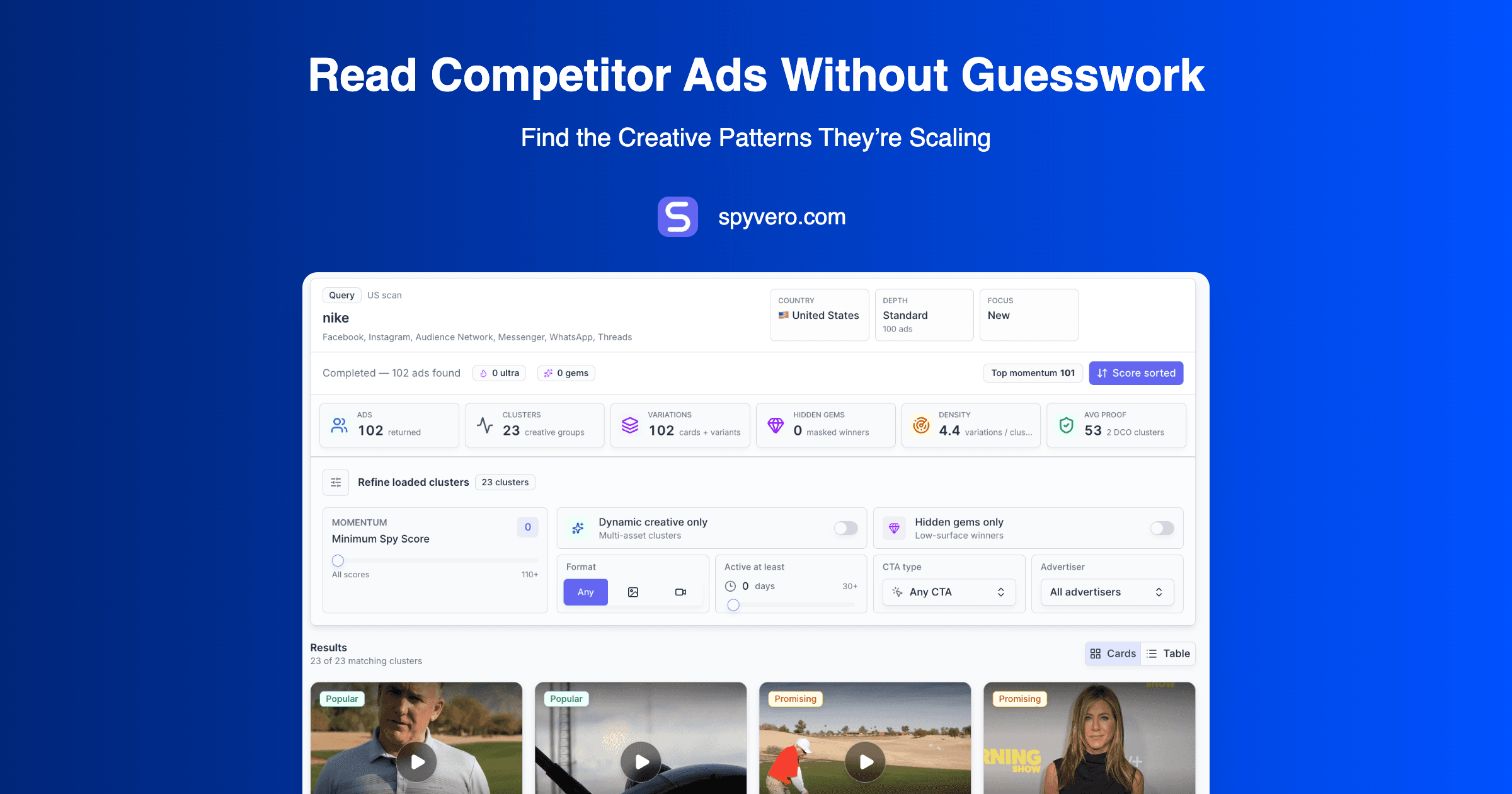
How to Read Competitor Meta Ads Without Guesswork
How to Read Competitor Meta Ads Without Guesswork
The Meta Ads Library is public, but public does not mean easy to read. A competitor can have hundreds of active ads, dozens of tiny copy changes, and multiple dynamic creative variants that all look almost identical at first glance.
The useful question is not "what ads are they running?" It is "which creative ideas are they confident enough to keep spending on?"
That is the difference between raw ad spying and competitive ad intelligence.
Start with the campaign pattern
Before you judge any individual ad, group the ads by the underlying creative idea. Most brands do not scale one perfect ad in isolation. They scale a pattern:
- The same hook with different product shots
- The same video with several headlines
- The same testimonial edited into multiple formats
- The same offer tested across images, reels, and carousels
When you group similar creatives together, the noise drops fast. One isolated ad might be a test. Twenty related ads around the same hook usually means the advertiser found something worth pushing.
Look for scale signals
Meta does not publish exact spend for most ads, so you have to read proxy signals. Useful signals include the number of active variants, how long a creative has stayed live, and whether similar versions keep appearing after the first test.
A practical review should ask:
- How many ads are built around the same concept?
- Has the creative survived for days, weeks, or months?
- Are new variants being added instead of the concept disappearing?
- Does the message appear across multiple formats?
Spyvero turns those signals into a SpyScore so you can sort competitor creatives by likely momentum instead of manually guessing from a long list.
Separate tests from winners
Short-lived ads are not useless, but they should not get the same attention as durable campaigns. A new creative with one active variant might reveal what a competitor is testing. A long-running cluster with many variants is more likely to reveal what they trust.
Use this simple split:
| Signal | Likely Meaning |
|---|---|
| One new ad | Early test |
| Many similar ads | Creative cluster |
| Long-running cluster | Possible winner |
| New variants added over time | Continued optimization |
| High volume plus longevity | Strong scaling candidate |
This framing keeps your team from copying every shiny ad that appears in the library.
Inspect the angle, not just the asset
Once you find a strong cluster, study the persuasion angle behind it. The asset matters, but the repeatable insight is usually deeper:
- What pain does the hook name?
- What proof does the ad rely on?
- Is the offer urgent, educational, emotional, or price-led?
- What objection is the creative trying to remove?
- Which audience would feel seen by this message?
The goal is not to clone the competitor. The goal is to understand what the market is responding to, then build a better version that fits your brand.
Monitor the market continuously
One audit gives you a snapshot. Monitoring gives you timing.
If you check competitors only once a month, you see the obvious winners after they have already been running for weeks. Daily or weekly monitoring helps you catch new clusters early, watch which ones survive, and react before the angle becomes crowded.
That is where ad intelligence becomes operational. Your creative reviews stop being based on stale screenshots and start being based on live competitive movement.
A better workflow
Use this process for every competitor or keyword audit:
- Search the brand, product category, or keyword.
- Cluster visually similar creatives.
- Sort by scale and longevity signals.
- Review the top clusters for hooks, proof, offer, and format.
- Save the strongest angles to your creative brief.
- Set a monitor for future changes.
Spyvero is built around that workflow: pull active Meta ads, cluster the creative noise, score the winners, and alert you when important new patterns appear.
Competitive research should not be a scroll session. It should be a repeatable system for finding the ideas your market is already validating.